


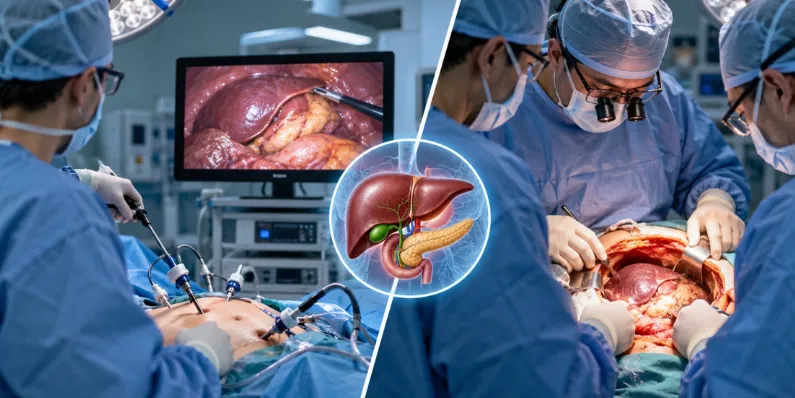
Choosing between a smaller-incision operation and traditional surgery can be confusing when you’re already dealing with a liver, pancreas, gallbladder, or bile duct problem.
I’m Dr. Bipin Vibhute, Liver & Multiorgan Transplant Surgeon at Jupiter Hospital, Pune, and I often explain that minimally invasive HPB surgery is not automatically better than open surgery.
The right approach depends on your diagnosis, anatomy, disease extent, and the operation you need.
Key Takeaways
- Minimally invasive surgery uses laparoscopic or robotic techniques through smaller incisions.
- Open surgery may be safer when the disease is extensive or the operation is technically complex.
- Selected liver operations can have benefits such as less blood loss and shorter recovery with a minimally invasive approach.
- Pancreatic and bile duct procedures require more individualised decision-making.
- The safest surgical approach is the one that allows the planned treatment to be completed properly.
What is the difference between minimally invasive and open HPB surgery?
The main difference is how the surgeon reaches the affected organ. Minimally invasive surgery uses a camera and specialised instruments through several small incisions, while open surgery uses a larger incision to provide direct access to the abdomen.
In laparoscopic HPB surgery, the surgeon views the operating area on a monitor and performs the procedure using long, specialised instruments. Robotic surgery uses a similar keyhole approach, with robotic instruments controlled by the surgeon.
The MedlinePlus overview of robotic surgery explains how it compares with laparoscopic and open surgery, and notes that it cannot always be used or be the best method for a specific problem. If the term HPB itself is new to you, see What Is HPB Surgery and When Is It Needed?
Open surgery provides wider direct access to the liver, pancreas, bile ducts, or surrounding structures. This can be particularly useful when the operation involves extensive disease, difficult anatomy, major blood vessels, or complex reconstruction.
Minimally Invasive vs Open HPB Surgery: Difference Table
| Feature | Minimally Invasive HPB Surgery | Open HPB Surgery |
| Surgical access | Performed through several small incisions using a camera and specialised instruments | Performed through a larger abdominal incision for direct access |
| Common techniques | Laparoscopic or robotic surgery | Traditional open surgery |
| Incision size | Usually smaller incisions | Usually one larger incision |
| Visibility | The surgeon views the operating area on a monitor; robotic systems may provide magnified, three-dimensional views | The surgeon has direct visual and physical access to the organs |
| Pain and wound discomfort | May cause less wound-related discomfort in selected procedures | May cause more incision-related discomfort because of the larger incision |
| Blood loss | May be lower in selected liver and other HPB procedures | May be higher in some procedures, although this varies with disease and surgical complexity |
| Hospital stay | May allow a shorter hospital stay in appropriately selected patients | May require a longer hospital stay, depending on the operation and recovery |
| Recovery | May support faster early mobility and recovery in selected cases | Recovery may take longer because of the larger incision and more extensive access |
| Best suited for | Selected, localised disease and procedures that can be safely completed through small incisions | Extensive disease, difficult anatomy, major vascular involvement, or complex reconstruction |
| Technical limitations | May be more challenging when disease is extensive or anatomy is difficult | Provides wider access and better direct control for complex operations |
| Conversion | May need to be converted to open surgery if this is safer during the operation | No conversion is required because the operation begins through an open approach |
| Cancer surgery | Can be appropriate for selected cancers when complete and safe removal is possible | May be preferred when it provides better access for complete disease removal |
| Main consideration | Smaller incisions do not automatically make it the safer option | A larger incision does not mean the operation is inappropriate or outdated |
This table provides a general comparison. The actual benefits, risks and recovery depend on the specific HPB procedure, your diagnosis, anatomy, overall health and the experience of the surgical team.
What are the possible advantages of minimally invasive HPB surgery?
Minimally invasive surgery may offer advantages such as smaller incisions, less wound-related discomfort and a shorter hospital stay in appropriately selected patients.
For certain liver resection procedures, studies have found lower blood loss, fewer complications and shorter hospital stays with laparoscopic surgery compared with open surgery.
However, these benefits don’t mean every liver operation should be performed laparoscopically. The complexity and location of the lesion, the amount of liver that needs to be removed and your overall health all matter.
When might open surgery be the better choice?
Open surgery may be preferred when the disease or anatomy makes a minimally invasive approach less suitable. The goal is not to use the smallest incision possible, but to perform the required operation safely and effectively.
For example, open surgery may be considered when there is:
- Extensive disease involving important blood vessels
- A large or difficult-to-access tumour
- Complex involvement of nearby organs
- Significant scarring from previous abdominal operations
- A need for complex reconstruction
- A major operation where direct access provides better control
Some major liver resections can now be performed using minimally invasive techniques in experienced centres, but open surgery continues to have an important role in complex cases.
Is minimally invasive surgery always better than open surgery?
No, minimally invasive surgery is not always the better option. It can provide meaningful recovery benefits in selected operations, but the safest approach depends on the individual procedure and patient.
I explain this carefully because patients sometimes assume that a smaller incision automatically means a better operation. That’s not necessarily true.
For example, evidence for minimally invasive liver surgery is encouraging, particularly for selected resections. Pancreatic surgery is more complex, and studies comparing laparoscopic and open pancreaticoduodenectomy have found differences in blood loss and some recovery measures, while several major outcomes remain comparable.
Can liver surgery be done laparoscopically?
Yes, selected liver operations, such as liver resection, can be performed laparoscopically, particularly when the location and size of the lesion and the patient’s overall condition make this approach appropriate.
The decision depends on factors such as:
- Location of the liver lesion
- Number and size of lesions
- Amount of liver that needs to be removed
- Relationship to major blood vessels and bile ducts
- Liver function
- Previous abdominal surgery
- Overall fitness for surgery
For appropriately selected patients, laparoscopic liver resection has been associated with lower blood loss and shorter hospital stays in clinical studies.
What about pancreatic and bile duct surgery?
Pancreatic surgery and bile duct surgery require particularly careful planning because these structures are closely connected to major blood vessels and other digestive organs. For example, pancreaticoduodenectomy, commonly called the Whipple procedure, is a complex operation.
Some pancreatic procedures can be performed laparoscopically or robotically in experienced centres. However, the evidence isn’t identical for every operation.
For example, pancreaticoduodenectomy, commonly called the Whipple procedure, is a complex operation. Recent evidence suggests minimally invasive approaches may reduce blood loss and, in some studies, hospital stay, but operative time can be longer and several important outcomes may be similar to open surgery.
The approach should therefore be chosen according to the operation required, rather than simply choosing the newest technique.
Does minimally invasive surgery mean less pain and faster recovery?
It can mean a more comfortable recovery for some patients, but the extent of the benefit depends on the operation. Smaller incisions can reduce wound-related discomfort, while the complexity of the internal surgery still determines much of your recovery.
A minor laparoscopic liver resection and a complex pancreatic operation are very different procedures. You shouldn’t expect the same recovery simply because both may use small incisions.
Your surgical recovery also depends on your general health, the extent of surgery, nutrition, liver function, complications and how quickly your digestive system resumes normal function.
Can minimally invasive surgery be converted to open surgery?
Yes, a planned minimally invasive operation may sometimes need to be converted to open surgery during the procedure. This decision is made when continuing through small incisions may not provide the safest way to complete the operation.
Reasons can include bleeding, unexpected anatomy, difficulty safely removing the disease, or a finding that wasn’t fully apparent before surgery.
I tell patients that conversion should not be viewed as a failure. If open surgery provides better control and safety, changing the approach is the appropriate surgical decision. Research on minimally invasive liver surgery has identified several factors associated with conversion, including previous surgery, cirrhosis, tumour characteristics and procedural complexity.
How is the HPB surgery approach decided?
The approach is decided after considering your diagnosis, scans, anatomy, overall health and the exact procedure required. There isn’t one surgical approach that is correct for every liver, pancreas, gallbladder, or bile duct condition.
During consultation with an HPB surgeon in Pune, I would typically consider:
- What condition needs treatment?
- Where exactly is the disease located?
- How extensive is it?
- Are major blood vessels involved?
- What operation is required?
- Have you had previous abdominal surgery?
- How well are your liver and other organs functioning?
- Which approach provides the safest way to achieve the treatment goal?
This is why an individual surgical assessment is more useful than choosing a procedure based only on the size of the incision.
Does the surgical approach affect cancer treatment?
For cancer surgery, the priority is complete and appropriate removal of the disease while maintaining patient safety. The surgical approach should not compromise the necessary cancer operation.
In selected pancreatic cancer patients, available evidence has not shown a clear disadvantage of minimally invasive surgery for several major oncological outcomes, although the quality and type of evidence vary by procedure.
For this reason, I don’t recommend choosing laparoscopic, robotic, or open surgery based on the technique alone. The disease, surgical objective, anatomy and experience of the treating team all need to be considered together.
Should you choose minimally invasive or open HPB surgery?
There is no universal answer. The better approach is the one that is appropriate for your particular disease and allows the surgeon to perform the required operation safely.
If you have been advised to undergo HPB surgery, ask your surgeon why a particular approach has been recommended, what alternatives are available, whether conversion to open surgery is possible, and what recovery you should realistically expect.
For a fuller list of questions to take to that consultation, see How to Choose an HPB Surgeon: Questions to Ask Before Surgery.
- Consult an HPB Specialist in Pune
If you’re considering liver, pancreatic, gallbladder, or bile duct surgery, you can consult me, Dr. Bipin Vibhute, Liver & Multiorgan Transplant Surgeon at Jupiter Hospital, Pune. I can review your diagnosis and imaging and explain which surgical approach may be appropriate for your specific condition.
Frequently Asked Questions
1.Is minimally invasive surgery always better than open surgery?
No, minimally invasive surgery is not always better. The best approach depends on the condition, complexity of the operation, anatomy and the patient’s overall health.
2.Can liver surgery be done laparoscopically?
Yes, selected liver resections can be performed laparoscopically. Whether this is suitable depends on the lesion’s location, size, number, relationship to important structures and the patient’s liver function.
3.Can minimally invasive surgery be converted to open surgery?
Yes, conversion to open surgery is sometimes necessary for safety. The decision may be made if bleeding, anatomy or disease extent makes it safer to continue with an open approach.
4.Is robotic surgery the same as laparoscopic surgery?
No, robotic surgery and conventional laparoscopy are different technologies, although both generally use small abdominal incisions. Robotic systems provide the surgeon with specialised instruments and a different method of instrument control.
5.Does open surgery mean the operation is more serious?
Not necessarily. The size of the incision doesn’t by itself determine how serious the underlying disease or operation is. Some complex procedures are appropriately performed through an open approach.
6.Will minimally invasive surgery always reduce my hospital stay?
No, a shorter hospital stay isn’t guaranteed. The duration depends on the procedure, recovery, complications and your overall health.
7.Can minimally invasive surgery be used for cancer?
Yes, minimally invasive surgery can be used for selected cancers, but suitability depends on the cancer’s location, extent and the operation required.
8.Does laparoscopic surgery have any disadvantages?
Yes, laparoscopic surgery has technical limitations in some complex operations. The surgeon may recommend open surgery when it provides safer access or better control.
9.How do I know if I am suitable for a minimally invasive operation?
Your surgeon needs to review your diagnosis, imaging, medical history and the planned procedure. Suitability cannot be determined from symptoms alone.
10.Should I ask for a second opinion before major HPB surgery?
A second opinion can be reasonable when you’re facing a major or complex operation and want greater clarity about the diagnosis, surgical approach or available alternatives.
Final Thoughts
Minimally invasive and open HPB surgery are both important surgical approaches. Neither is automatically right or wrong.
The correct choice depends on your disease, anatomy, overall health and the operation you need. A detailed assessment by an experienced HPB surgical team can help you understand why a particular approach has been recommended and what you can expect during recovery.
Medical Disclosure
This article is provided for general educational purposes only. It does not replace an individual medical consultation, physical examination, diagnosis, or personalised treatment plan. The appropriate surgical approach varies according to each patient’s medical condition and the procedure required.
Recent Comments