


Fatty Liver, NAFLD, and NASH — Same Disease, Very Different Danger Levels
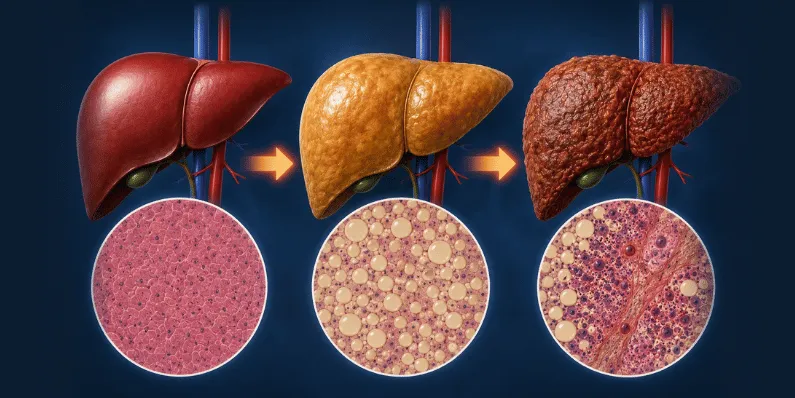
Your ultrasound report says fatty liver. Your doctor mentions NAFLD. Someone online is talking about NASH. Are these the same thing? Is one worse than the other? And where exactly do you stand?
These three terms confuse patients every single day — and that confusion often leads to inaction at precisely the moment when action matters most.
At The Liver Transplant in Pune, Dr. Bipin Vibhute, Liver and Multiorgan Transplant Surgeon, helps patients understand exactly what their liver diagnosis means and what needs to happen next.
If you are searching for fatty liver treatment in Pune or trying to make sense of a recent diagnosis, this article cuts through the noise — with the clinical tables and stage-specific treatment information that most patient content leaves out.
Key Takeaways:
- Fatty liver, NAFLD, and NASH are not three separate diseases — they are stages of one progressive condition
- Simple fatty liver is common and often reversible; NASH is serious and can lead to permanent scarring
- You can have significant liver damage without feeling any symptoms
- Not everyone with fatty liver progresses to NASH — but those who do are often the ones who waited
- Knowing your stage is the only way to know how urgently you need to act
Are Fatty Liver, NAFLD, and NASH Actually the Same Disease?
Yes — they are the same underlying condition at different points on a spectrum.
Understanding where one ends and the next begins determines your risk, your treatment, and your timeline.
NAFLD — nonalcoholic fatty liver disease — is the umbrella term. It covers every stage of liver fat accumulation in people who drink little or no alcohol.
Within NAFLD, there are two distinct clinical realities.
Simple Fatty Liver (NAFL)
The first is simple fatty liver — medically called NAFL or hepatic steatosis. Fat has accumulated in the liver cells. There is no significant inflammation. No meaningful cell damage. The liver is coping, just burdened.
NASH — Where the Real Danger Begins
The second is NASH — nonalcoholic steatohepatitis. Here, fat has triggered active inflammation and is now destroying liver cells. This is where the real danger begins.
The 2023 Renaming — MASLD
One important note for patients in India: these conditions are increasingly referred to as MASLD — metabolic dysfunction-associated steatotic liver disease — a newer term adopted by international liver societies in 2023.
You may see this in newer reports or referral letters. It refers to the same spectrum of disease, renamed to better reflect its metabolic origins.
The Disease Spectrum — From Fatty Liver to Cirrhosis
Because this is a direct stage-by-stage progression that patients need to understand visually, a structured comparison genuinely improves clarity:
|
Stage |
Medical Term |
What Is Happening |
Reversible? |
Urgency |
|
Stage 1 |
Simple Fatty Liver / NAFL |
Fat in liver cells, no inflammation |
Yes — with lifestyle change |
Moderate — act now before progression |
|
Stage 2 |
NASH (early) |
Fat + inflammation + liver cell injury |
Largely yes — with treatment |
High — active damage occurring |
|
Stage 3 |
NASH with Fibrosis (F1–F3) |
Scarring developing alongside inflammation |
Partially — early fibrosis can regress |
Very high — specialist management needed |
|
Stage 4 |
Cirrhosis (F4) |
Advanced irreversible scarring |
No — management and transplant assessment |
Critical — complications require specialist care |
|
Stage 5 |
Decompensated Cirrhosis |
Liver failing, complications present |
No |
Emergency — transplant evaluation urgent |
What Is Simple Fatty Liver — And Should You Actually Worry?
Simple fatty liver is exactly what it sounds like: fat stored inside liver cells beyond the normal threshold.
Clinically, a liver is considered fatty when more than 5% of its cells contain fat deposits.
Why It Happens
The liver does not store fat by choice. It stores fat because the body is sending it more fat and sugar than it can process and export.
Insulin resistance, excess caloric intake — particularly from refined carbohydrates and sugar — and sedentary habits are the primary drivers.
The liver becomes a storage overflow for metabolic excess.
Certain dietary and lifestyle patterns significantly raise this risk; 4 Reasons Why Indians Are at Radar of Fatty Liver explains why South Asians are particularly vulnerable, including how refined diets and genetic predisposition combine to accelerate fat accumulation even at lower body weights.
Why Most People Feel Nothing
Simple fatty liver produces no symptoms in the vast majority of cases. It is detected incidentally — during an ultrasound done for something else, or when elevated liver enzymes show up on routine blood work.
This incidental discovery is common and often rattles patients who felt perfectly fine moments before.
Is It Reversible?
Yes — and this is the most important message at this stage.
Simple fatty liver is one of the most reversible conditions in medicine when caught early. Meaningful weight loss, dietary change, and improved metabolic control can normalise liver fat.
The liver’s regenerative capacity at this point is significant. The window for easy reversal is open — but it requires action, not observation.
What Makes NASH Different — And Why Is It More Serious?
NASH is not just more fat. It is fat plus inflammation plus active liver cell destruction happening simultaneously.
The Shift From Storage to Injury
When fat accumulation crosses a threshold and begins generating toxic byproducts inside liver cells, the immune system responds.
Immune cells flood the liver tissue, releasing inflammatory signals. Those signals damage healthy cells. The liver begins to lose functional tissue.
This process — hepatic inflammation with ballooning degeneration of liver cells — is what defines NASH histologically.
It cannot be detected by ultrasound or blood test alone. It requires either a FibroScan or, definitively, a liver biopsy.
The Fibrosis That Follows
When liver cells are repeatedly injured and the body attempts repair, scar tissue forms. This is liver fibrosis.
Fibrosis is graded on a scale of F0 to F4. F0 means no scarring. F4 means cirrhosis — advanced, largely irreversible structural damage.
To understand this scarring process in depth, Fibrosis of the Liver covers how fibrosis develops, what it means for long-term liver function, and why early detection changes outcomes.
The critical reality: fibrosis can progress at different speeds in different patients. Some stay at early fibrosis for decades. Others progress to cirrhosis within a few years.
Diabetes, obesity, and ongoing metabolic dysfunction are the main accelerators.
Can Simple Fatty Liver Skip Directly to Advanced Fibrosis?
Yes — it can. Research involving serial liver biopsies has shown that patients with simple fatty liver can progress to significant fibrosis without the expected gradual ladder.
Diabetes at follow-up was present in 80% of those who progressed rapidly, making metabolic control the single most important protective factor at every stage.
How Do Doctors Tell These Stages Apart?
Blood Tests — Starting Point, Not a Diagnosis
Elevated ALT and AST — liver enzymes in routine blood work — suggest liver stress.
But normal enzymes do not rule out NASH or early fibrosis. Many patients with active liver inflammation have normal enzyme levels for extended periods.
Blood tests alone cannot stage the disease.
Ultrasound — Detects Fat, Not Damage
An abdominal ultrasound can identify liver fat and give a rough sense of severity.
It cannot distinguish between simple fatty liver and NASH. It cannot reliably detect early fibrosis.
It is useful as a first screening step — nothing more.
FibroScan — The Practical Next Step
A FibroScan (transient elastography) measures liver stiffness, which correlates directly with the degree of fibrosis.
It is non-invasive, takes minutes, and is widely available. For most patients, this is the most practical way to assess disease stage without a biopsy.
If you are wondering what the procedure involves and what your results mean, Is a FibroScan Beneficial to Your Liver? provides a clear patient-friendly explanation of how the test works and when it is recommended.
Liver Biopsy — The Definitive Answer
Liver biopsy remains the gold standard for staging NAFLD versus NASH and grading fibrosis precisely.
It is not needed for every patient — but for those with elevated enzymes, significant stiffness on FibroScan, or multiple metabolic risk factors, it provides what no other test can.
Diagnostic Tests Compared — What Each One Can and Cannot Tell You
|
Test |
Detects Fat |
Detects Inflammation (NASH) |
Stages Fibrosis |
Invasive? |
Availability |
|
Blood Tests (ALT/AST/FIB-4) |
Indirectly |
Partially |
Partially (FIB-4) |
No |
All hospitals |
|
Ultrasound |
Yes (moderate–severe) |
No |
No (except cirrhosis) |
No |
All hospitals |
|
FibroScan (TE + CAP) |
Yes (more sensitive) |
No |
Yes (F0–F4) |
No |
Specialist centres |
|
MRI-PDFF |
Yes (most accurate) |
No |
No |
No |
Tertiary centres |
|
MR Elastography |
Yes |
No |
Yes (very accurate) |
No |
Selected centres |
|
Liver Biopsy |
Yes |
Yes |
Yes (gold standard) |
Yes |
Hospitals with hepatology |
What Does Treatment Look Like Across These Stages?
For Simple Fatty Liver — Lifestyle Is the Treatment
The treatment is lifestyle — structured, sustained, and specific.
A 7–10% reduction in body weight produces measurable improvement in liver fat. A diet limiting refined carbohydrates, added sugar, and processed food — while emphasising vegetables, legumes, whole grains, and healthy fats — is the most evidence-backed approach.
Exercise of 150 minutes per week at moderate intensity independently reduces liver fat even without scale weight change.
For NASH and Early Fibrosis — Urgency Increases
Everything above applies — with greater urgency.
Metabolic control becomes non-negotiable: blood sugar, blood pressure, and triglycerides must be actively managed.
Resmetirom — the first FDA-approved drug specifically for NASH with F2–F3 fibrosis (approved March 2024) — is now available for eligible patients in specialist settings.
GLP-1 receptor agonists (semaglutide, liraglutide) show meaningful NASH activity improvement alongside weight reduction.
Pioglitazone remains evidence-supported for NASH in patients with concurrent type 2 diabetes.
To understand the specific role vitamins and antioxidants play alongside these therapies, see Role of Vitamins for NASH Treatment.
For Advanced Fibrosis and Cirrhosis — Goal Shifts
At this stage, the goal shifts from reversal to stabilisation — preventing further progression, managing complications, and monitoring for liver cancer.
Liver cancer surveillance (6-monthly ultrasound plus AFP) is recommended for all F4 patients.
In cases of end-stage liver disease, transplant evaluation becomes relevant.
Stage-Specific Treatment Summary
|
Stage |
Primary Treatment |
Medication Options |
Monitoring |
Specialist Needed? |
|
Simple Fatty Liver |
Weight loss 7–10%, Mediterranean diet, 150 min/week exercise |
None routinely indicated |
Annual liver enzymes + FibroScan |
Optional but advisable |
|
NASH (no fibrosis) |
Same as above, urgent metabolic control |
GLP-1 agonists (if diabetes/obesity), Vitamin E (non-diabetic) |
6-monthly enzymes, annual FibroScan |
Yes |
|
NASH F1–F2 Fibrosis |
Same + strict diabetes/lipid/BP management |
Pioglitazone, GLP-1 agonists, resmetirom (if eligible) |
6-monthly FibroScan, annual biopsy if progressing |
Yes — hepatologist |
|
NASH F3 Fibrosis |
All above + bariatric surgery consideration |
Resmetirom (eligible), GLP-1 agonists |
6-monthly FibroScan + HCC surveillance |
Yes — liver specialist |
|
Cirrhosis F4 |
Complication prevention, no alcohol, nutrition support |
Treat complications specifically |
6-monthly ultrasound + AFP, endoscopy |
Liver transplant centre |
|
Decompensated Cirrhosis |
Transplant evaluation |
Complication-specific |
As directed by transplant team |
Liver transplant team |
Location-Based Treatment Access in Pune
For patients in Pune and the surrounding region — including Pimpri-Chinchwad, Hadapsar, Kothrud, Baner, and Viman Nagar — specialist NASH and fatty liver assessment is available at The Liver Transplant under Dr. Bipin Vibhute.
If you are looking for a trusted fatty liver treatment specialist in Pune, the clinic offers a full spectrum of diagnostic and management services under one roof, from non-invasive FibroScan staging to personalised nutrition guidance and advanced hepatology care.
Services Available for NAFLD/NASH Management in Pune
FibroScan assessment in Pune — liver stiffness and CAP fat measurement for non-invasive staging.
NASH fibrosis staging Pune — combining FIB-4, FibroScan, and clinical assessment to determine your exact disease stage.
Fatty liver diet consultation Pune — Mediterranean diet planning and structured nutritional guidance for liver fat reduction.
NASH specialist consultation Pune — comprehensive hepatology review including metabolic co-factor assessment, medication review, and personalised management planning.
Liver transplant assessment Pune — for patients with advanced fibrosis or cirrhosis who require transplant evaluation.
If you have been told you have a fatty liver — or if your blood tests keep showing elevated liver enzymes and no one has given you a clear explanation — this is the time to get a proper liver assessment, not reassurance that it is “just fatty liver.”
Dr. Bipin Vibhute at The Liver Transplant (thelivertransplant.com) provides expert evaluation of fatty liver disease stages in Pune, including FibroScan assessment and personalised management plans. Book a consultation and find out exactly where you stand.
How Quickly Does Fatty Liver Progress — What Speeds It Up?
The honest answer: it varies significantly — and the variables within your control are metabolic.
The Key Accelerators
Diabetes is the single most powerful accelerator of progression from simple fatty liver to fibrosis.
Obesity — particularly visceral fat around the abdomen — is the second. High triglycerides and uncontrolled blood pressure compound the risk further.
Patients who manage their metabolic health — who bring their blood sugar under control, reduce abdominal fat, and change their diet — frequently show stable or improving liver status on follow-up FibroScan.
Patients who dismiss the diagnosis and make no changes often progress silently until the damage is significant.
The disease moves at the pace you allow it to.
Risk Factors That Accelerate NASH Progression
|
Risk Factor |
Effect on Progression |
Modifiable? |
|
Type 2 diabetes |
2–3x faster fibrosis progression |
Yes — glucose control |
|
Obesity (especially visceral fat) |
Drives insulin resistance and fat overload |
Yes — weight loss |
|
High triglycerides |
Increases hepatic fat load |
Yes — diet and medication |
|
Hypertension |
Compounds metabolic syndrome |
Yes — medication and lifestyle |
|
Sleep apnoea |
Nocturnal hypoxia activates scar-forming cells |
Yes — CPAP treatment |
|
PNPLA3 genetic variant |
2–4x increased fibrosis risk |
No — requires closer monitoring |
|
Alcohol use (even modest) |
Direct hepatotoxic synergy with NASH |
Yes — complete abstinence |
|
Hypothyroidism |
Slows hepatic fat metabolism |
Yes — hormone replacement |
|
Sedentary lifestyle |
Reduces fat oxidation, worsens insulin resistance |
Yes — 150 min/week exercise |
Final Thoughts
Fatty liver, NAFLD, and NASH are not interchangeable terms for a vague liver problem. They represent a clear progression — from manageable to serious to irreversible — and knowing exactly where you are on that spectrum determines what you need to do and how urgently you need to do it.
Simple fatty liver, caught early, is one of the most treatable conditions in medicine. NASH with early fibrosis can still be meaningfully reversed. Advanced cirrhosis cannot.
The difference between these outcomes is almost always diagnosis timing and action. If a report has told you your liver is fatty, treat it as information that requires a response — not a label to file away and forget.
Ready to find out exactly where your liver stands? Book a specialist consultation with Dr. Bipin Vibhute at thelivertransplant.com in Pune. Expert fatty liver treatment in Pune with FibroScan staging, personalised management plans, and access to the full spectrum of NASH care from lifestyle support to liver transplant evaluation. Visit thelivertransplant.com to book your appointment today.
Frequently Asked Questions
Can fatty liver go away on its own without any treatment?
Simple fatty liver can improve with lifestyle changes, but it rarely resolves entirely on its own without deliberate dietary and activity changes. Waiting and hoping tends to allow the underlying metabolic conditions to continue driving fat accumulation. The earlier action is taken, the more complete the reversal.
How long does it take for fatty liver to turn into NASH?
There is no fixed timeline — progression depends on your metabolic health, genetics, and lifestyle. Some people remain at the simple fatty liver stage for life; others progress to NASH within a few years, particularly if diabetes or obesity is present and unmanaged. Serial FibroScan monitoring every 1–2 years is the most practical way to track your individual trajectory.
Do I need a liver biopsy if my FibroScan result is normal?
Not necessarily. A normal FibroScan with normal liver enzymes and no high-risk metabolic factors is generally reassuring. Your doctor will assess whether a biopsy adds useful information based on your complete clinical picture, including FIB-4 score and risk factor profile.
Is NASH common in India specifically?
Yes. India has a high and rising prevalence of NAFLD and NASH driven by increasing rates of type 2 diabetes, visceral obesity, and diets high in refined carbohydrates. South Asians develop significant liver fat at lower body weights compared to Western populations, making metabolic risk assessment more important than BMI alone.
Can someone with NASH drink alcohol occasionally?
No amount of alcohol is considered safe in the presence of NASH. Even moderate alcohol consumption adds direct toxic stress to a liver that is already inflamed and under metabolic pressure. Most liver specialists advise complete abstinence once NASH is confirmed.
Written By

Similar Posts

Sahyadri Hospital Conducts 100th Liver Transplant Op
Source::Times Of IndiaAbout 50% of the pediatric patients who require a liver transplant have biliary atresia. Other disease states that progress to end-stage liver disease among...
Sahyadri Hospiatal Conducts 100th Liver Transplant Op
Source::Times Of IndiaAbout 50% of the pediatric patients who require a liver transplant have biliary atresia. Other disease states that progress to end-stage liver disease among...
Sahyadri Hospital Conducts 100th Liver Transplant Op
Source::Times Of IndiaAbout 50% of the pediatric patients who require a liver transplant have biliary atresia. Other disease states that progress to end-stage liver disease among...