


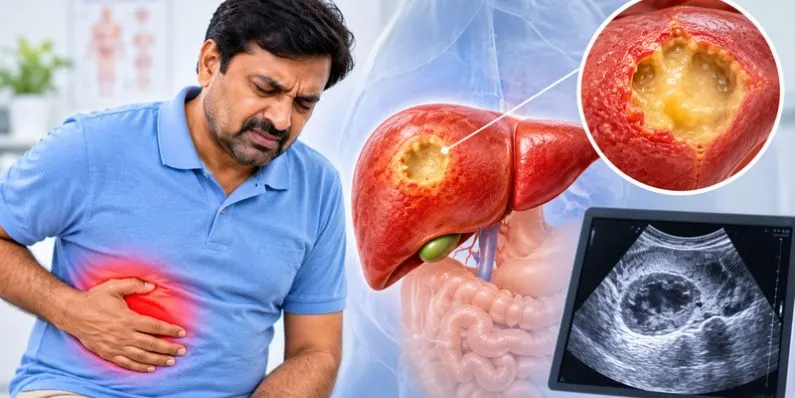
A persistent fever with pain on the right side of the abdomen should not be ignored, especially when the cause isn’t clear.
A liver abscess is a pocket of pus inside the liver caused by an infection. Treatment may involve medicines alone or medicines with a drainage procedure, depending on the type, size, location and response to treatment.
Dr. Bipin Vibhute is a Liver & Multiorgan Transplant Surgeon in Pune, with a clinical focus on liver and complex abdominal conditions.
Key Takeaways
- A liver abscess is a collection of pus caused by a bacterial or parasitic infection.
- Fever, chills and right upper abdominal pain are common symptoms.
- Ultrasound, CT scans and blood tests help confirm the diagnosis.
- Some abscesses respond to medicines, while others need image-guided drainage.
- Treating the underlying cause and attending follow-up appointments help reduce the risk of recurrence.
What is a liver abscess?
A liver abscess is a collection of pus that forms inside the liver when an infection damages liver tissue.
Pus contains dead cells, bacteria or other microorganisms, and fluid produced during the body’s response to infection.
A collection can develop in one part of the liver or in multiple areas. Its size and location influence the treatment plan.
There are two common types:
1. Amoebic liver abscess
An amoebic abscess develops due to a parasite called Entamoeba histolytica. MedlinePlus’s overview of amebic liver abscess explains how the parasite travels from the intestine to the liver.
A pyogenic abscess develops due to bacteria. MedlinePlus’s overview of pyogenic liver abscess notes that treatment usually combines drainage through a tube in the skin with about four to six weeks of antibiotics.
The infection usually enters the body through food or water contaminated with faecal matter. It can affect the intestine and then spread to the liver through the bloodstream.
A person with an amoebic abscess may not have diarrhoea or other obvious intestinal symptoms.
2. Pyogenic liver abscess
A pyogenic abscess develops due to bacteria.
Bacteria may reach the liver through infected bile ducts, the bloodstream or an infection in another part of the abdomen.
Common bacteria include Escherichia coli and Klebsiella pneumoniae, although other organisms can also be responsible.
The distinction matters because treatment differs. Doctors select medicines and decide about drainage after considering the likely cause and investigation results.
What causes an abscess in the liver?
A liver abscess develops when bacteria or parasites reach the liver and cause an infection that leads to a collection of pus.
The infection can reach the liver in different ways.
1. Contaminated food and water
The parasite responsible for amoebic infection can enter the body through contaminated food or drinking water.
Poor sanitation and inadequate hand hygiene can increase the risk of exposure.
2. Infection in the bile ducts
The bile ducts are small tubes that carry bile from the liver towards the intestine.
A gallstone, narrowing or blockage can prevent normal bile flow and encourage infection. This may lead to infection spreading into the liver.
3. Infection in the abdomen
Conditions such as appendicitis, diverticulitis or an intestinal infection can sometimes allow bacteria to spread towards the liver.
4. Spread through the bloodstream
In some cases, bacteria travel through the blood from an infection elsewhere in the body and reach the liver.
5. Previous procedures or surgery
Certain procedures involving the bile ducts or liver may increase the risk of infection, particularly when there is an underlying blockage or other complication.
Who has a higher risk?
Some factors can increase the chance of developing an abscess:
- Diabetes: Poorly controlled blood sugar can affect the body’s ability to fight infection. For how diabetes affects the liver more broadly, see Managing Liver Health In Diabetic Patients.
- Bile duct disease: Stones, narrowing or infection can interfere with normal bile flow.
- Weakened immunity: Some illnesses and medicines reduce the body’s ability to control infections.
- Previous abdominal infection or procedure: These may provide a route for bacteria to reach the liver.
Having one of these risk factors does not mean a person will develop an abscess. It helps doctors understand the possible source when symptoms appear.
What are the symptoms of a liver abscess?
Fever, chills and pain in the upper right side of the abdomen are common symptoms, although some patients develop less obvious signs.
Symptoms may develop over several days or gradually over a longer period.
Common symptoms include:
- Fever and chills: The body responds to the infection, sometimes with sweating or shivering.
- Right upper abdominal pain: Pain or tenderness may occur below the right side of the rib cage.
- Loss of appetite: Patients may feel full or have little interest in food.
- Nausea and vomiting: Some people experience stomach discomfort or vomiting.
- Unexplained weight loss: A prolonged infection can affect appetite and general health.
- Weakness and tiredness: The infection can leave the person feeling exhausted.
Can a liver abscess cause jaundice?
Yes. Some patients develop jaundice, which causes yellowing of the eyes and skin.
This may happen when infection or inflammation affects the flow of bile. A blockage in the bile ducts may also be responsible.
Jaundice with fever and abdominal pain needs urgent medical assessment, as it may indicate a serious infection involving the bile ducts.
Not every patient experiences all these symptoms. A person can have an abscess even without obvious digestive complaints.
How is a liver abscess diagnosed?
Doctors diagnose an abscess using a combination of symptoms, physical examination, blood tests and imaging scans.
The tests help confirm the collection, assess its size and location, and identify the likely cause.
1. Physical examination and medical history
The doctor asks about fever, abdominal pain, appetite, recent infections, diabetes and previous abdominal or bile duct procedures.
The abdomen is examined for tenderness or enlargement of the liver.
2. Blood tests
Blood tests help identify infection and assess how the liver and other organs are functioning.
They may include:
- Complete blood count (CBC): Checks white blood cells, which may increase during infection.
- C-reactive protein (CRP): Measures inflammation in the body.
- Liver function tests assess liver-related blood markers and possible bile flow problems; What is a Liver Function Test? explains the individual results. An abdominal ultrasound can identify a collection and estimate its size and location, and Liver Health: Why Regular Ultrasounds are Essential explains what it can and cannot show.
- Blood cultures: Help identify bacteria circulating in the bloodstream.
3. Ultrasound scan
An abdominal ultrasound uses sound waves to create images of the liver.
It can identify a collection, estimate its size and location, and help doctors plan further tests or drainage.
4. Contrast-enhanced CT scan
A CT scan provides more detailed images of the liver and surrounding organs.
It helps doctors assess the number of collections, their position and possible complications. It can also help identify a possible source of infection.
5. Tests to identify the organism
Depending on the suspected cause, doctors may request tests for amoebic infection.
If drainage is performed, the collected pus can be sent for laboratory testing to identify bacteria and determine which antibiotics are likely to work.
Identifying the cause is important because treatment for a parasitic infection is not the same as treatment for a bacterial infection.
Can a liver abscess be treated without drainage?
Yes. Some liver abscesses can be treated with medicines alone, but the decision depends on the type of infection, the patient’s condition and the response to treatment.
Treatment of an amoebic abscess
Doctors usually treat an uncomplicated amoebic abscess with anti-amoebic medicines.
These medicines act against the parasite responsible for the infection. A second medicine may be prescribed to clear the parasite from the intestine and reduce the chance of recurrence.
Routine drainage is not necessary for every uncomplicated amoebic abscess.
However, doctors may consider drainage if the patient does not improve, the abscess has features that increase the risk of rupture or there is concern about a complication.
Treatment of a bacterial abscess
A bacterial abscess generally needs antibiotics that act against the likely bacteria.
The doctor may start treatment before culture results are available, then adjust the medicines according to laboratory findings and the patient’s response.
Many bacterial abscesses also need drainage to remove the infected material. In selected patients with small collections who respond well to antibiotics, medicines alone may be considered.
Why shouldn’t patients take antibiotics on their own?
Different infections need different medicines. The wrong antibiotic or an incomplete course may fail to control the infection.
Do not start, stop or change antibiotics without medical advice. The treatment plan should be based on clinical assessment and investigation results.
When is liver abscess drainage needed?
Drainage is considered when an abscess is large, is unlikely to respond adequately to medicines alone, has a risk of rupture or is causing complications.
The decision is not based on size alone. Doctors also consider the type of infection, location, number of collections, thickness of the pus and the patient’s overall condition.
Drainage may be advised in situations such as:
- A large collection: Larger abscesses may be less likely to resolve with medicines alone, particularly when they contain a substantial amount of pus.
- Poor response to medicines: Persistent fever, pain or signs of infection despite appropriate treatment may indicate the need for drainage.
- Risk of rupture: A collection close to the liver surface or in a vulnerable location may need urgent attention.
- Left-lobe abscess: Certain left-sided collections may carry a higher risk of serious complications if they rupture.
- Uncertain diagnosis: Removing a sample of fluid can help doctors identify the organism and distinguish an abscess from other liver conditions.
- Complications: A ruptured abscess or infection spreading into the abdomen may require urgent intervention.
Does every abscess larger than 5 cm need drainage?
No. A measurement of 5 cm is not an absolute rule for every patient.
Size is one factor in the decision. The type of abscess, its location, symptoms, imaging findings and response to medicines also matter.
For example, an uncomplicated amoebic abscess may respond to medicines even when it is larger, while a bacterial abscess may need drainage as part of treatment.
The treating team decides the safest approach after reviewing the complete clinical picture.
What happens during liver abscess drainage?
Most drainage procedures are performed through the skin using ultrasound or CT guidance, without the need for a large abdominal incision.
This approach is called percutaneous drainage. It allows the doctor to reach the collection through a planned path while viewing its position on an imaging screen.
1. Preparation
The medical team reviews the scan, blood tests and the patient’s general condition.
Doctors also check blood clotting and other factors that may affect the safety of the procedure.
2. Needle aspiration
In selected cases, the doctor inserts a thin needle through the skin and removes the pus.
This is called needle aspiration. The collected sample may be sent for culture and other tests.
Some patients may need repeat aspiration if the collection remains or builds up again.
3. Catheter drainage
For collections that need continuous drainage, the doctor may place a thin tube called a catheter into the abscess.
The tube allows pus to flow into an external collection bag. It may remain in place until the amount of drainage reduces and imaging or clinical assessment shows improvement.
4. Monitoring after the procedure
The team monitors pain, fever, vital signs and the amount of fluid coming through the catheter.
The patient may also need antibiotics or other medicines during this period.
When is surgery needed instead?
Surgical drainage is not the first option for most patients. For how surgeons decide when an operation is the right choice, see What Is HPB Surgery and When Is It Needed?
It may be considered when:
- Image-guided drainage is not possible or has not worked.
- The abscess has ruptured.
- There are multiple complex collections.
- The patient has another abdominal condition that also needs surgery.
The aim is to control the infection safely and treat the source of the problem.
How long does recovery from a liver abscess take?
Recovery depends on the type and size of the abscess, the treatment used and whether complications develop.
Some patients improve with medicines, while others need drainage and a longer period of treatment.
During recovery, doctors monitor:
- Fever and pain: These should gradually improve with effective treatment.
- Blood test results: White blood cell counts and inflammation markers help assess the response.
- Drain output: If a catheter is used, the amount and appearance of fluid are monitored.
- Imaging findings: Follow-up ultrasound or CT may be advised to assess the remaining collection.
- General health: Appetite, strength and daily activity are reviewed.
How long are antibiotics needed?
The duration varies according to the organism, severity of infection, adequacy of drainage and response to treatment.
Bacterial infections often need several weeks of antibiotics. Amoebic infections require a different medicine schedule.
Do not stop treatment just because fever or pain has improved. Complete the prescribed course and attend follow-up appointments.
What should patients do after going home?
- Take medicines exactly as prescribed.
- Keep the drainage site clean and follow the team’s instructions if a catheter remains in place.
- Attend scheduled blood tests and scans.
- Eat regular, balanced meals as tolerated.
- Avoid strenuous activity until the doctor confirms it is safe.
Contact the treating team if fever returns, pain worsens or the drainage tube becomes blocked, comes out or develops redness and discharge around the entry site.
Can a liver abscess return, and how can recurrence be reduced?
A liver abscess can return, especially if the infection’s underlying cause is not treated.
For example, a bile duct stone or narrowing may continue to cause infection even after the collection has been drained.
The treatment plan should therefore address both the abscess and the condition that allowed it to develop.
Steps that may help reduce recurrence include:
- Treat bile duct problems: Stones, narrowing or blockage may need specific treatment.
- Control diabetes: Keep blood sugar within the target range advised by your doctor.
- Complete the prescribed medicines: Follow the full treatment plan for bacterial or amoebic infection.
- Maintain food and water hygiene: Drink safe water, wash hands before eating and prepare food hygienically.
- Attend follow-up appointments: Blood tests and scans help doctors confirm that the infection is resolving.
Patients with repeated infections may need further investigations to identify an underlying problem.
When should you seek urgent medical care for a suspected liver abscess?
Seek prompt medical assessment if you have persistent fever with pain in the upper right abdomen, particularly if symptoms are worsening.
Some signs may indicate a severe infection or complication.
Get urgent medical help if you experience:
- High fever with severe chills or shivering.
- Severe or worsening abdominal pain.
- Yellowing of the eyes or skin with fever.
- Repeated vomiting or inability to drink fluids.
- Severe weakness, dizziness or fainting.
- Confusion, rapid breathing or difficulty breathing.
Confusion, fainting, breathing difficulty or signs of shock require emergency care. These symptoms can occur with sepsis, a serious response to infection that can affect the whole body.
Don’t wait for a routine appointment if these warning signs appear.
Final Thoughts
A liver abscess needs timely diagnosis because the infection can worsen or spread if left untreated. The right treatment depends on whether the collection is amoebic or bacterial, its size and location, and how the patient responds to medicines.
Not every patient needs drainage, but when it is required, image-guided treatment can help remove the infected material and support recovery. Treating the underlying cause and completing follow-up are also important.
If you have been diagnosed with an abscess or have reports showing a liver collection, you can consult Dr. Bipin Vibhute, Liver & Multiorgan Transplant Surgeon, in Pune for an assessment. His work covers HPB and liver surgery, including complex abdominal conditions.
Frequently Asked Questions
- Is a liver abscess contagious?
A liver abscess itself does not spread from one person to another through ordinary contact. However, the parasite that causes amoebic infection can spread through food or water contaminated with faecal matter.
- Can a liver abscess be mistaken for a tumour?
Yes. Some liver collections can resemble cysts or tumours on an initial scan. Doctors use detailed imaging, clinical findings and, when needed, fluid or tissue testing to distinguish them.
- Can liver function tests be normal in a person with a liver abscess?
Yes. Liver blood tests do not always show the same pattern in every patient. Doctors interpret them along with symptoms, infection markers and imaging.
- Can a liver abscess affect the lungs?
Yes. A collection near the upper surface of the liver can sometimes irritate the diaphragm or affect the area around the lung. New chest pain, cough or breathing difficulty needs medical assessment.
- Can a person develop a liver abscess after gallbladder surgery?
It is possible, although it is not a routine outcome of gallbladder surgery. Infection, bile duct problems or other complications may sometimes lead to an abscess and need investigation.
- Can a liver abscess cause diabetes?
A liver abscess does not usually cause diabetes directly. However, infection can disturb blood sugar control, particularly in someone who already has diabetes.
- Should family members get tested if one person has a liver abscess?
Usually, family members do not need routine liver scans or blood tests just because one person has an abscess. If an amoebic infection is suspected, a doctor can advise on hygiene and whether anyone with symptoms needs testing.
- Can a person return to work after liver abscess treatment?
Yes, many patients return to work after recovery, but the timing depends on the severity of the infection, the treatment received and the type of work. The treating doctor should confirm when normal activities can safely resume.
- Can a liver abscess be seen on a routine ultrasound?
Yes. An abdominal ultrasound can often identify a liver collection. A CT scan may be needed to understand its size, location and relationship with nearby structures in more detail.
- Is it safe to travel while recovering from a liver abscess?
Travel may need to be postponed until the infection is controlled and the patient is medically stable. Ask the treating doctor before travelling, especially if you still have fever, a drainage catheter or ongoing complications.
Medical Disclaimer
This article is for general educational purposes and does not replace medical consultation, diagnosis or treatment. The cause, severity and treatment of a liver abscess vary between patients. Do not self-medicate or delay medical assessment if you have persistent fever, abdominal pain or other warning signs. Always follow the advice of a qualified doctor who has reviewed your symptoms, medical history, blood tests and imaging reports.
Recent Comments