


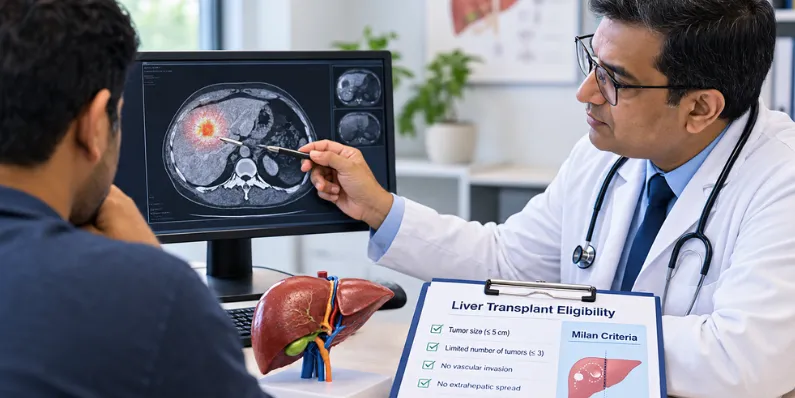
Being diagnosed with liver cancer can leave patients and families wondering whether a transplant is still possible. The answer depends on the size and number of tumours, whether cancer has spread, and the condition of the remaining liver.
A liver transplant for liver cancer can be a treatment option for carefully selected patients with hepatocellular carcinoma (HCC), particularly when the cancer is within accepted transplant criteria and the patient is medically fit for surgery.
At Dr. Bipin Vibhute’s practice, we focus on liver and multiorgan transplant care, helping patients understand their diagnosis and available treatment pathways.
Key Takeaways
- The Milan criteria help doctors assess whether HCC is suitable for liver transplantation.
- One tumour up to 5 cm, or up to three tumours each up to 3 cm, may meet these criteria.
- There should be no major blood vessel invasion or cancer spread outside the liver.
- Selected patients outside Milan criteria may be reconsidered after successful downstaging.
- Liver function, AFP levels, general health and transplant-centre policies also influence eligibility.
What is hepatocellular carcinoma, and when is liver transplant considered?
Hepatocellular carcinoma (HCC) is the most common type of primary liver cancer, meaning it starts in the liver itself.
HCC often develops in people with long-term liver damage. Common underlying conditions include:
- Liver cirrhosis: Long-term scarring that affects normal liver function.
- Chronic hepatitis B: A long-lasting viral infection that can increase liver cancer risk.
- Chronic hepatitis C: A viral infection that can cause liver inflammation and scarring.
- Metabolic dysfunction-associated steatotic liver disease (MASLD): A condition involving excess fat in the liver. See Fatty Liver, NAFLD, and NASH for how the stages differ.
Why is liver transplant considered for selected HCC patients?
A transplant removes the affected liver, including the visible cancer, and replaces it with a healthy donor liver.
This is an important difference between transplantation and treatments that target only the tumour. A transplant can also address the underlying cirrhotic liver, which may otherwise remain at risk of developing further cancer.
Doctors may consider transplantation when:
- The tumour meets accepted transplant selection criteria.
- The cancer has not spread outside the liver.
- There is no major tumour invasion into important blood vessels.
- The patient’s liver disease makes surgical removal of only the tumour unsuitable.
- The patient is medically fit for transplantation.
Is transplant the only treatment for HCC?
No. Treatment depends on the cancer stage, liver function, tumour location and the patient’s general health.
Other options may include:
- Liver resection: Surgical removal of the part of the liver containing the tumour. See liver resection for when it is possible.
- Radiofrequency or microwave ablation: Using heat to destroy selected tumours.
- Transarterial chemoembolisation (TACE): Delivering treatment through the artery supplying the tumour while reducing its blood supply.
- Radioembolisation (TARE): Delivering tiny radioactive particles through the tumour’s blood supply.
- Systemic therapy: Medicines that act throughout the body, used in selected cases.
A transplant team evaluates whether transplantation offers a suitable treatment option compared with these alternatives.
What are the Milan criteria for liver transplant?
The Milan criteria are a set of tumour size and number limits used to identify selected patients with HCC who may benefit from liver transplantation.
A patient meets the standard Milan criteria when they have either:
- One tumour measuring 5 cm or less, or
- Up to three tumours, with each tumour measuring 3 cm or less.
In both situations, there must also be:
- No major blood vessel invasion by the tumour.
- No cancer spread outside the liver.
Milan criteria at a glance
- Single tumour: maximum diameter of 5 cm.
- Multiple tumours: maximum of 3 nodules.
- Each nodule: maximum diameter of 3 cm.
- No macrovascular invasion.
- No extrahepatic spread.</escape>
Why do doctors use these criteria?
Tumour size and number provide information about the extent of cancer.
A tumour that has entered major blood vessels or spread to other organs is more likely to recur after transplantation.
The Milan criteria help reduce the risk of transplanting a patient whose cancer may return after surgery. They are a selection guide, not a complete assessment of the patient’s health or cancer behaviour.
The criteria were developed to identify patients with favourable outcomes after transplantation. They come from a landmark 1996 study in the New England Journal of Medicine and remain an important reference in HCC transplant assessment. For how the stage of liver cancer shapes treatment, see Liver Cancer Stages: Your Treatment & Prognosis Guide.
Who is eligible for a liver transplant with HCC?
A patient may be considered for transplantation when the tumour meets accepted selection criteria, the cancer is confined to the liver, and the patient is medically suitable for major surgery.
Meeting the Milan criteria is an important step, but it does not automatically guarantee eligibility.
Doctors assess several factors.
1. Tumour size and number
The number of tumours and their measurements are reviewed on detailed imaging.
Doctors check whether the cancer falls within the accepted criteria or whether another approved selection pathway may apply.
2. Blood vessel involvement
The portal vein and hepatic veins are important blood vessels connected to the liver.
Major invasion of these vessels by the tumour can increase the risk of cancer recurrence and may make transplantation unsuitable under standard selection criteria.
Doctors carefully review scans for signs of this involvement.
3. Cancer spread outside the liver
The team checks whether the cancer has spread to other organs or lymph nodes.
A transplant removes the liver, but it cannot remove cancer that has already spread elsewhere in the body.
4. Liver function and portal hypertension
The team assesses how well the liver is working and whether the patient has complications of cirrhosis.
Portal hypertension, which means increased pressure in the blood vessels supplying the liver, may influence whether resection or transplantation is more suitable.
5. Alpha-fetoprotein (AFP) levels
AFP is a protein measured through a blood test. Some liver cancers produce higher levels of this protein.
A high or rising AFP level can indicate more active tumour behaviour.
AFP is considered along with scan findings, tumour response and other clinical information. It cannot confirm or rule out HCC on its own.
6. General medical fitness
A transplant is major surgery. Doctors assess heart and lung function, kidney health, infections, nutrition and other medical conditions.
The team also reviews whether the patient can safely take long-term medicines after transplantation.
Eligibility is decided by the complete medical assessment, not by tumour measurements alone.
What tests are needed before a transplant decision?
Doctors use detailed scans, blood tests and medical assessments to understand the cancer stage, liver function and the patient’s fitness for transplantation.
The main investigations may include:
1. Multiphasic CT scan or MRI
A multiphasic CT or MRI takes images of the liver at different stages after contrast injection.
These scans help doctors assess:
- Tumour size and number.
- Blood supply and enhancement pattern of the tumour.
- Relationship with major blood vessels.
- Signs of cancer spread.
- Changes after previous treatment.
For patients being considered for transplantation, the transplant centre should review the imaging carefully.
2. AFP blood test
AFP levels can help doctors assess tumour behaviour and monitor the response to treatment.
A falling AFP level after treatment may be encouraging, but it must be interpreted with repeat imaging and the full clinical picture.
3. Chest imaging
A CT scan of the chest may be advised to look for cancer spread to the lungs.
Additional investigations are selected according to the patient’s symptoms and scan findings.
4. Liver and kidney function tests
Blood tests help assess liver function, kidney function, blood counts, clotting and other health factors.
These results help the team plan surgery and post-transplant care.
5. Overall transplant assessment
The assessment may involve a hepatologist, transplant surgeon, anaesthetist, radiologist, medical oncologist and other specialists.
The final decision is made after reviewing the cancer stage, liver condition, general health and suitability of the donor pathway. For the general tests every transplant candidate goes through, see Liver Transplant Eligibility: Who Qualifies and Which Tests Are Done?
Can someone outside the Milan criteria still receive a liver transplant?
Some patients who initially fall outside the Milan criteria may still be considered for transplantation after further assessment or successful downstaging.
However, this is not automatic. The transplant centre must assess the tumour’s behaviour, treatment response and the applicable selection rules.
What are expanded transplant criteria?
Some transplant programmes use criteria that allow selected patients with slightly larger or more numerous tumours to be considered.
One example is the UCSF criteria, which are broader than the Milan criteria.
The commonly described UCSF limits include:
- One tumour measuring 6.5 cm or less.
- Or up to three tumours, each measuring 4.5 cm or less.
- The total diameter of the tumours should not exceed 8 cm.
- No major vascular invasion or cancer spread outside the liver.
These are separate selection criteria, not an automatic replacement for Milan criteria. The criteria accepted by a transplant programme and organ-allocation system may differ.
In India, the NOTTO transplant manual describes UCSF criteria for routine deceased-donor liver transplant wait-list eligibility. Living-donor transplant selection may follow the individual centre’s protocol. Patients should confirm the applicable rules with the transplant centre.
What if the tumour is larger than the accepted limit?
Doctors may consider additional treatment to reduce the tumour burden in selected patients.
The decision depends on whether the cancer responds to treatment and whether there is evidence of aggressive disease.
Being outside the Milan criteria does not mean that every treatment option is closed. It means the case needs a careful, specialist assessment.
What are bridging therapy and downstaging before transplant?
Bridging therapy and downstaging are treatments used to control HCC before transplantation, but they serve different purposes.
What is bridging therapy?
Bridging therapy aims to prevent the tumour from growing while the patient waits for a suitable transplant.
It is considered when the patient already meets the required transplant criteria but may have to wait for a donor liver.
Possible treatments include:
- TACE: A procedure that delivers treatment to the tumour through its blood supply.
- Thermal ablation: Using heat to destroy selected cancer tissue.
- TARE: A procedure that delivers radioactive particles to the tumour.
- Stereotactic body radiotherapy (SBRT): Focused radiation directed at the tumour in selected cases.
The choice depends on tumour location, size, liver function and the centre’s expertise.
What is downstaging?
Downstaging is used when the tumour initially exceeds accepted transplant limits.
The aim is to reduce the amount of active cancer so that the remaining tumour burden falls within the transplant criteria used by the centre.
For example, a patient may have a tumour larger than the Milan limit. After treatment, imaging may show a smaller area of viable cancer.
Doctors assess the remaining active tumour, not simply the original tumour size or the area of dead tissue after treatment.
How do doctors know whether downstaging has worked?
They review:
- Repeat CT or MRI scans.
- Changes in tumour size and number.
- AFP levels and their trend.
- Whether new tumours have appeared.
- Whether there is any vascular invasion or spread outside the liver.
A period of observation may also be recommended to understand the tumour’s behaviour.
A good response to treatment over time can provide useful information about the cancer’s biology and help the team decide whether transplantation is appropriate.
Can a patient receive a living-donor liver transplant for HCC?
Yes. A selected patient with HCC may be considered for a living-donor liver transplant if the recipient meets the centre’s transplant criteria and a suitable donor is medically and legally approved.
For how donors are assessed, see Liver Donor Eligibility in India: Who Can Donate a Liver?
In a living-donor transplant, a healthy person donates a portion of their liver to the recipient.
The donated portion and the recipient’s remaining liver tissue can grow over time.
Does having a donor guarantee eligibility?
No. Having a willing family member or another potential donor does not automatically make transplantation suitable.
The recipient must still undergo cancer staging and transplant assessment.
The team considers:
- Tumour size and number.
- Blood vessel involvement.
- Cancer spread outside the liver.
- AFP and tumour response.
- The recipient’s general health.
How is the donor assessed?
The donor’s safety is a separate priority.
The donor undergoes medical and psychological assessment to check liver health, anatomy, fitness for surgery and understanding of the risks.
The team also reviews blood group compatibility and the size of the donated liver portion.
What are the legal requirements in India?
Living-donor transplantation in India must follow the Transplantation of Human Organs and Tissues Act and applicable rules.
The required relationship documents, consent and Authorisation Committee approvals depend on the donor category and circumstances. NOTTO publishes the official forms for living donation, including the certificate of medical fitness of the donor and the authorisation committee certificate.
Living donation must be voluntary and cannot involve payment for an organ. The recipient and donor should receive separate, clear explanations of the risks and approval process.
What happens if liver cancer grows while waiting for a transplant?
If the cancer grows while a patient is waiting, the transplant team reassesses the tumour stage and may recommend additional treatment.
This is one reason why regular monitoring is essential.
The team may recommend:
- Repeat CT or MRI scans.
- AFP testing.
- TACE, ablation or another suitable treatment.
- Review of whether the patient still meets transplant criteria.
- Reassessment of the overall treatment plan.
If the tumour progresses beyond the accepted criteria, the patient may no longer qualify under that transplant pathway.
This does not mean that care stops. Other cancer treatments may still be appropriate depending on the stage, liver function and general health.
What is recovery like after a liver transplant for HCC?
Recovery involves healing from major surgery, taking medicines to protect the new liver and attending regular appointments to monitor for complications or cancer recurrence.
The hospital stay and recovery period vary from patient to patient.
1. Hospital recovery
After surgery, the patient is monitored closely in the intensive care unit or a specialised transplant recovery area.
The team checks liver function, blood flow to the transplanted liver, kidney function, blood counts and signs of infection or rejection.
2. Immunosuppressive medicines
After transplant, the body’s immune system may recognise the new liver as foreign and try to attack it.
Immunosuppressive medicines reduce this risk and help prevent rejection.
These medicines need to be taken exactly as prescribed. The patient should not stop or change them without speaking to the transplant team.
3. Cancer follow-up
Patients transplanted for HCC need regular surveillance to check for recurrence.
Follow-up may include:
- AFP blood tests.
- CT or MRI scans.
- Liver and kidney function tests.
- Review of medicines and possible side effects.
The frequency of testing depends on the patient’s cancer features and transplant team’s protocol.
4. Returning to daily activities
Patients gradually increase their activity as they recover.
Good nutrition, adequate rest, infection prevention and regular follow-up are important parts of long-term care.
Recovery does not end when the patient leaves the hospital. Lifelong transplant follow-up is necessary. For practical steps that support recovery, see 6 Ways To Improve Your Recovery After Liver Transplant, and for general guidance on monitoring after cancer treatment, Post-Liver Cancer Treatment Care.
Can liver cancer return after a transplant, and how is recurrence monitored?
Yes. HCC can return after transplantation in some patients, which is why long-term follow-up is essential.
A transplant removes the affected liver, but it cannot guarantee that microscopic cancer cells have not already spread elsewhere.
The risk of recurrence depends on several factors, including:
- Tumour size and number.
- Blood vessel invasion identified in the final examination of the removed liver.
- AFP levels before transplant.
- Tumour response to treatment.
- Features seen in the final pathology report.
The pathology report examines the removed liver and tumour under a microscope. It may provide information that could not be confirmed fully through scans before surgery.
How is recurrence monitored?
The transplant team creates a follow-up plan based on the patient’s risk.
It may include regular AFP testing and imaging of the abdomen and chest.
Patients should attend all scheduled follow-up appointments, even when they feel well. Early assessment of new symptoms or abnormal test results helps the team decide whether further investigation is needed.
Final Thoughts
A liver transplant can offer an important treatment option for selected patients with HCC, particularly when the cancer is within accepted transplant criteria and the underlying liver disease also needs treatment.
The Milan criteria provide a recognised starting point, but they are not the only part of the decision. Tumour behaviour, AFP levels, liver function, overall health, treatment response and the applicable transplant programme rules all matter.
If you or a family member has been diagnosed with HCC, a consultation with Dr. Bipin Vibhute, Liver & Multiorgan Transplant Surgeon, in Pune can help you understand the reports and discuss the appropriate transplant assessment pathway. Bring your latest CT or MRI scans, AFP results, liver function reports and previous treatment records.
Frequently Asked Questions
- Does a patient need a liver biopsy before being considered for transplant?
Not always. In patients with cirrhosis or certain high-risk conditions, characteristic findings on multiphasic CT or MRI may establish an HCC diagnosis without a biopsy. The treating team decides whether tissue sampling is needed.
- Can a person with hepatitis B receive a liver transplant for HCC?
Yes. Selected patients with hepatitis B-related liver disease can undergo transplantation. They need an appropriate plan to prevent hepatitis B from recurring in the new liver.
- Can a patient with fatty liver-related cirrhosis receive a transplant for HCC?
Yes. Selected patients with cirrhosis related to metabolic or fatty liver disease may be considered. The team assesses cancer stage, liver function and other medical conditions.
- Does a high AFP level always mean that liver cancer has spread?
No. AFP can rise in HCC, but it can also increase in some non-cancer liver conditions. Doctors interpret the result with imaging, medical history and changes over time.
- Can a patient receive a transplant if the tumour is close to the portal vein?
Possibly, depending on whether the tumour is merely close to the vessel or has invaded it. Detailed imaging review is needed to make this distinction.
- Can a patient have another liver tumour after a successful transplant?
Yes, a new or recurrent tumour can develop in some patients. Regular imaging and AFP monitoring help the transplant team look for signs of recurrence.
- Will a patient need cancer treatment after a liver transplant?
Not every patient needs additional cancer treatment after transplantation. The need depends on the final pathology report, recurrence risk and the transplant team’s assessment.
- Can a patient with HCC receive a transplant if they are above 65 years of age?
Age alone does not decide eligibility. Doctors assess heart and lung health, kidney function, physical fitness, cancer stage and whether the patient can safely undergo surgery and long-term care.
- Can a patient with two liver tumours receive a transplant under Milan criteria?
Yes, if there are no more than three tumours and each measures 3 cm or less, with no major vascular invasion or cancer spread outside the liver. The transplant team must confirm the findings on imaging.
- Can a patient return to normal work after a liver transplant?
Many patients return to work and daily activities after recovery, although the timing depends on their health, type of work and progress after surgery. The transplant team should guide when it is safe to resume work.
Medical Disclaimer
This article is intended for general educational purposes and does not replace medical consultation, diagnosis or treatment. Liver transplant eligibility for HCC depends on tumour size and number, vascular involvement, cancer spread, AFP levels, liver function, general health and the rules of the transplant programme. Milan criteria are a guide and do not guarantee acceptance or rejection for transplantation. Always consult a qualified liver transplant team for an individual assessment.
Recent Comments